

A wallet gives you an estimate before you send. A confirmed Ethereum receipt tells you what you actually paid. To check the charge, you need two numbers from the receipt: gas used and effective gas price. The amount of ETH you sent can stay out of the calculation.
Download the Ethereum gas receipt worksheet for Excel or LibreOffice. It opens offline. Two examples are filled in, and the last column is yours. You can do the same calculation by hand below.
Recalculate a real transfer
On September 19, 2025, an Ethereum mainnet transaction moved exactly 1 ETH. Open the public transaction on Etherscan and expand the gas details. The transfer used 21,000 gas. The effective price was 1.419411051 gwei per unit. One billion gwei make one ETH.
21,000 × 1.419411051 ÷ 1,000,000,000 = 0.000029807632071 ETH. Compare that answer with the “Transaction Fee” field. The receiver got 1 ETH and the sender covered the fee separately.
The receipt also shows a maximum price of 1.594224882 gwei. If you used that figure, your answer would be too high. A wallet can authorize a ceiling above the price the network ultimately charges. Similarly, the gas limit caps the amount of work the transaction can consume. Look for the amount actually used.
Why a failed swap can cost more than a successful transfer
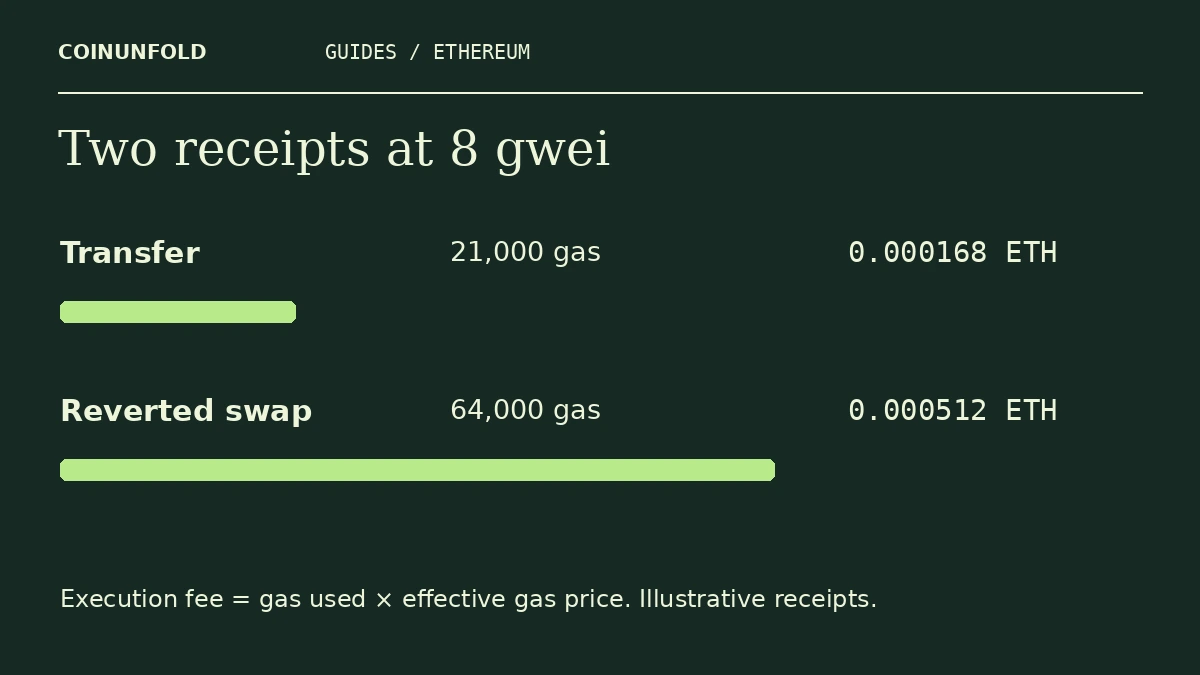
Imagine two receipts at the same effective price of 8 gwei. A plain transfer uses 21,000 gas and costs 0.000168 ETH. A swap runs part of a contract, then reverts after using 64,000 gas. Its execution fee is 0.000512 ETH. No swap completes, but the network has already processed the instructions leading up to the failure.
A wallet can also show a failed simulation before broadcast, or an old pending transaction can disappear. Those situations are different from an included transaction marked “Fail.” Look for a block number and a receipt on the correct network. If another transaction replaced the original, inspect the one that actually made it into a block. Ethereum’s gas documentation explains how execution and unused gas are accounted for.
Turn the ETH charge into dollars or rupees
Use the ETH price for the time you want to measure. At an illustrative $2,500 per ETH, the two sample fees are $0.42 and $1.28. At an illustrative ₹210,000 per ETH, they are ₹35.28 and ₹107.52. The sample prices are round numbers for practice. For historical records, keep the price source and timestamp alongside the receipt. The ETH fee stays fixed even as today’s currency equivalent changes.
When the worksheet fits
Use it for the execution fee on an ordinary Ethereum mainnet receipt. A rollup can charge an additional data fee, and a centralized exchange may set a separate withdrawal charge. A swap can also have a pool fee and price impact. If you are comparing two routes for a purchase, check the guide to reading a DEX quote before adding everything into one total.