
Two swap screens offer the same token. One puts a bigger number in green. Does that make it the better decentralized exchange? Only if both quotes buy the same asset, on the same network, for the same total cost. You can do most of this comparison before signing anything.
A decentralized exchange, or DEX, lets a wallet trade through blockchain-based protocols. Your wallet authorizes an action. Depending on the design, software can route the order through pools of tokens or ask participants to compete to fill it. The website, wallet and underlying contracts each play a part.
Uniswap and CoW Swap answer different questions
For a first look at a pool-based swap, use Uniswap’s quote details to see how the size of a trade can affect the price. A pool holds assets that traders can exchange under rules set by a contract. A large order relative to the pool can move the price substantially. The Uniswap interface may offer different routes, so read the details for the quote you actually have. Uniswap explains price impact and slippage.
CoW Swap offers a useful second comparison on supported chains. With its intent-based approach, you sign conditions for a trade. Participants called solvers compete to find ways to fill orders, including matching orders or accessing other sources of liquidity. An order can expire without filling. Read what your signature allows and how long the order remains valid. CoW Protocol describes its auction design.
Read a 100-token quote
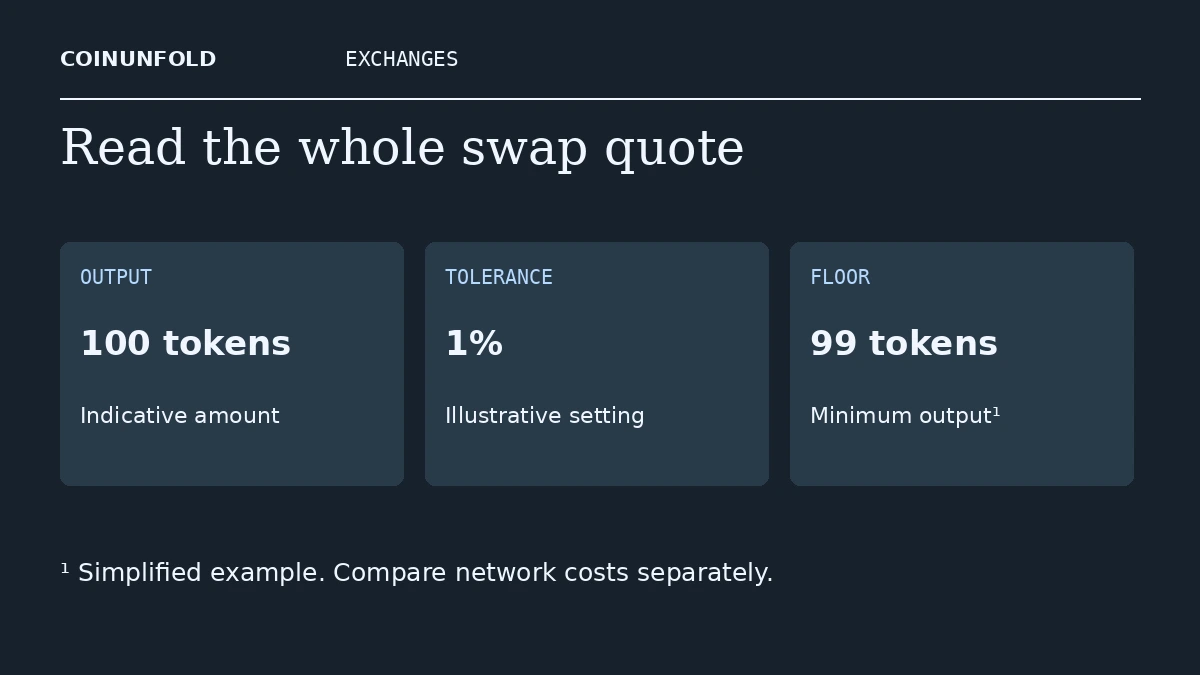
Suppose a simple swap previews 100 output tokens and gives a minimum of 99. At that moment you expect about 100. In this example, a tolerance of 1% allows execution down to 99. That one token is a limit on a worse fill, not an automatic charge. Below the allowed minimum the swap should fail or stay unfilled, depending on how it was submitted. A reverted on-chain transaction can still cost gas.
Price impact is the change your own order causes. It can already be reflected in the 100-token estimate. Slippage is the difference between the price expected and the one obtained at execution. Raising tolerance doesn’t make the pool deeper. If increasing the input sharply worsens the exchange rate in the preview, reconsider the trade size and route.
Compare like for like
Open both quotes close together in time. Match the network, input amount and token contract address. Compare the estimated output, minimum received, separate network costs and any extra approval transaction. Don’t deduct a fee twice if it’s already in the quoted output. An approval prompt deserves its own read: which contract can spend which token, and how much?
If your starting balance is rupees or dollars in a bank, a wallet swap may still require a separate on-ramp. Include that leg in your comparison. If the destination is another chain, investigate the bridge as a separate product. For a bank-funded route, start with our centralized exchange guide.
After a swap is included, use the Ethereum gas receipt worksheet to check the network fee.