

An account starts at $10,000, rises to $10,600 and slips back to $9,750. Did the trader fail? On the exact same series of trades, one rulebook could say yes and another could say no. The missing detail is where the firm draws the loss line.
Balance generally reflects closed trades and booked charges. Equity also reflects what open positions are worth now. If a program measures equity throughout the day, waiting to close a losing position won’t keep the loss out of the calculation.
A static floor stays put
Suppose a fictional program permits an $800 total loss from the initial $10,000. Its floor starts at $9,200 and stays there. At $9,750, equity is still $550 above the floor. That answers the overall-loss question only. A separate daily limit might already have been hit.
A trailing floor can move up
Now suppose the program instead sets the floor $800 below the highest equity observed, with no cap or reset. Initially the floor is still $9,200. When equity reaches $10,600, the floor rises to $9,800. At $9,750 the account is $50 below it. Giving back a gain changed the outcome even though the loss relative to the starting balance is just $250.
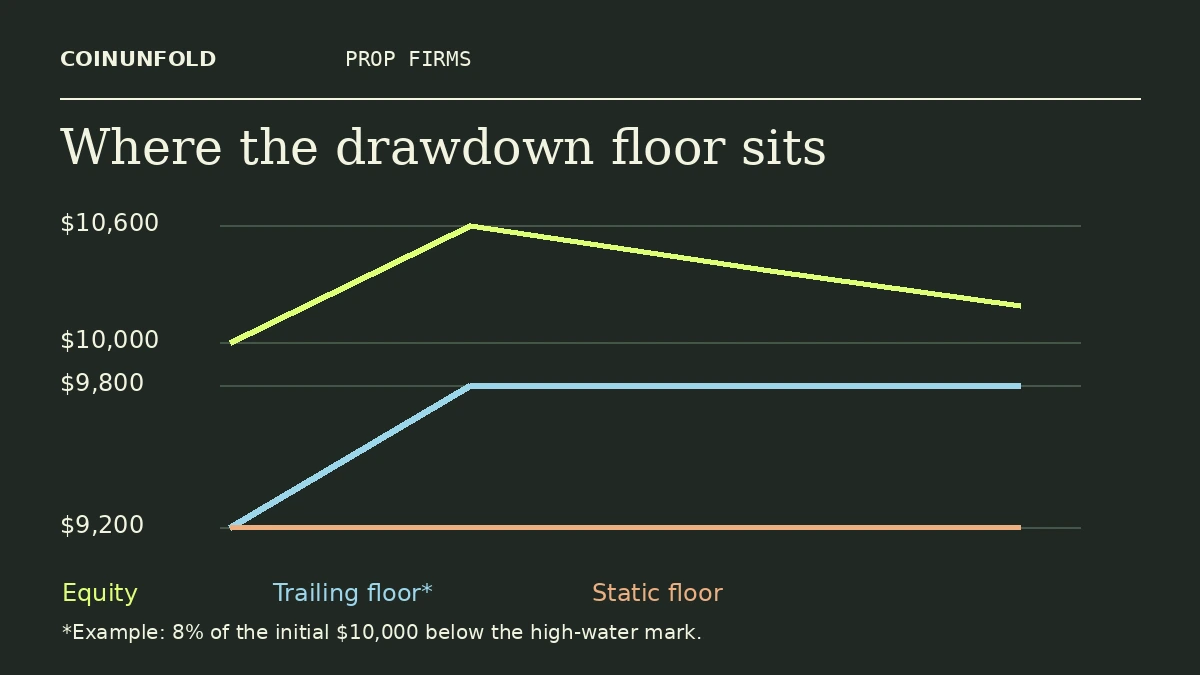
These figures illustrate a fixed dollar distance equal to 8% of the initial account. A rule that recalculates 8% of each new peak gives a different answer. Firms may measure the peak only at the end of the day, measure balance instead of equity, or stop trailing at a specified point. Look for the exact reference value in the terms.
A daily rule has its own clock
For a separate illustration, suppose today’s floor is calculated as the starting daily balance of $10,200 minus a $400 allowance. Today’s floor is $9,800. A booked loss of $250 leaves the balance at $9,950. Another $180 of open losses takes equity to $9,770, below the floor even before further fees. If tomorrow starts with an open position, learn how the provider treats it at reset.
FTMO’s material provides a real example of a firm defining its daily rule with a particular time zone and including open profit or loss in equity. Its products have different objectives. The numbers above are teaching examples. Use the terms for your own program when making a calculation. FTMO’s daily-loss explanation
Two numbers to write down
Write down the current daily floor and current overall floor in the account currency. If both apply at all times, the higher floor is the one you reach first as equity falls. Then check whether touching the boundary counts as a breach and how commissions or funding charges affect equity. That small piece of arithmetic is more informative than the account size in an ad. For the rest of the contract, see how crypto prop firms work.