
A checkout page offers a “$50,000 funded account” for a fraction of that amount. What exactly changes hands? Typically, the buyer pays for access to an evaluation. The amount in the headline is the size used to calculate trades and rules. You don’t receive $50,000 in a wallet you can withdraw from.
Traditional proprietary trading involves a firm trading its own capital. Online crypto evaluation programs use some of the same vocabulary. Their contracts can describe simulated balances, performance-based rewards and restrictions quite different from a job at a trading desk. Read the agreement for the particular plan you’re considering.
Follow the money through a challenge
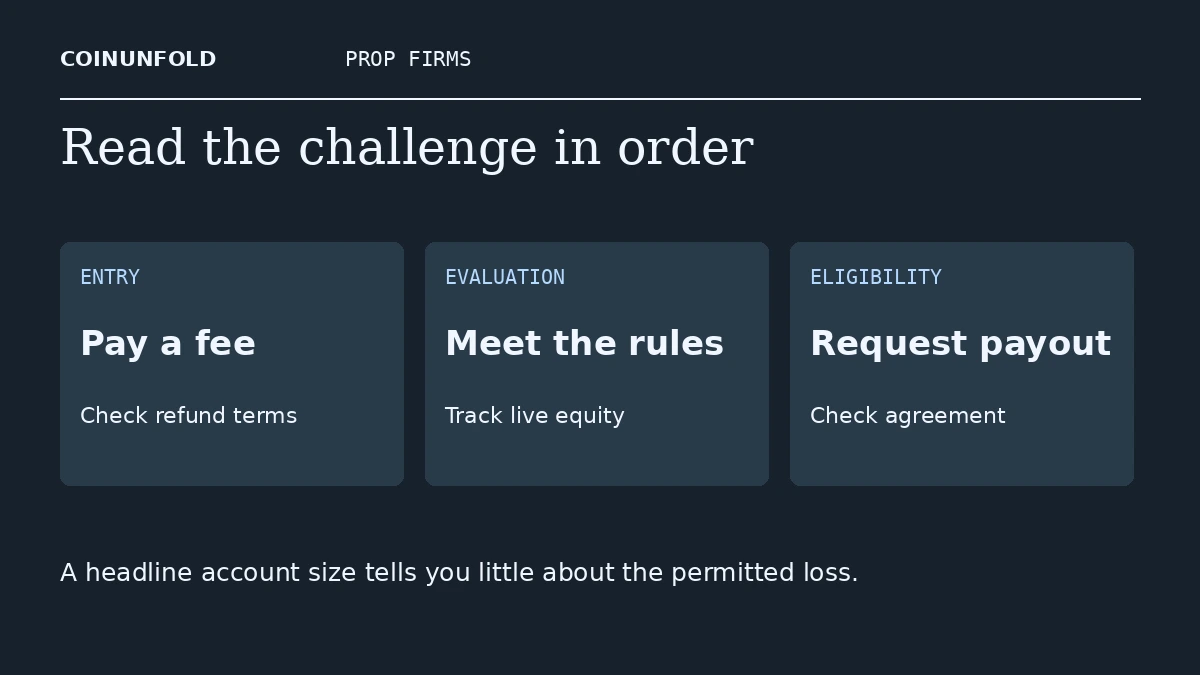
First comes an entry fee. Check what it buys, whether a failed attempt requires another payment, and what conditions apply to any refund. Next comes an evaluation. The trader may have to reach a profit target while staying above daily and overall equity floors. Other conditions can govern position sizes, allowable strategies and which instruments can be traded.
Passing can make someone eligible for the next account or agreement. The provider might require identity checks before permitting a payout. A “profit split” describes a portion of eligible profits under that agreement. An 80% split on a hypothetical $400 of eligible profit would be $320 before any applicable charges. The starting account size is irrelevant to that multiplication.
What an actual rulebook says
Breakout’s published program rules say its trading balances use simulated capital, evaluation-stage results are ineligible for payouts, and identity verification is required for access to a Breakout Account and payout eligibility. It also lists separate daily and total loss rules. Someone can understand the profit target perfectly and still fail by crossing an equity limit. These are the provider’s stated terms. They don’t establish an individual trader’s payout history. Read Breakout’s program rules.
Work out how much room the rules give you
Consider an invented $50,000 evaluation with a fixed loss floor of $47,500. The distance between the starting line and that floor is $2,500. If a separate daily rule allows only $1,000 of loss that day, the daily rule can end the attempt much sooner. An open position can count against an equity limit before you close the trade. Our drawdown example shows how to do that arithmetic.
Before paying, try to find five answers in writing: the legal operator, eligibility for where you live, which balance is simulated, the event that ends the account, and the point at which a reward can actually be requested. Keep the dated terms for your plan. If you can find the account size in seconds but can’t find the payout agreement, you still don’t know what you’re buying.