

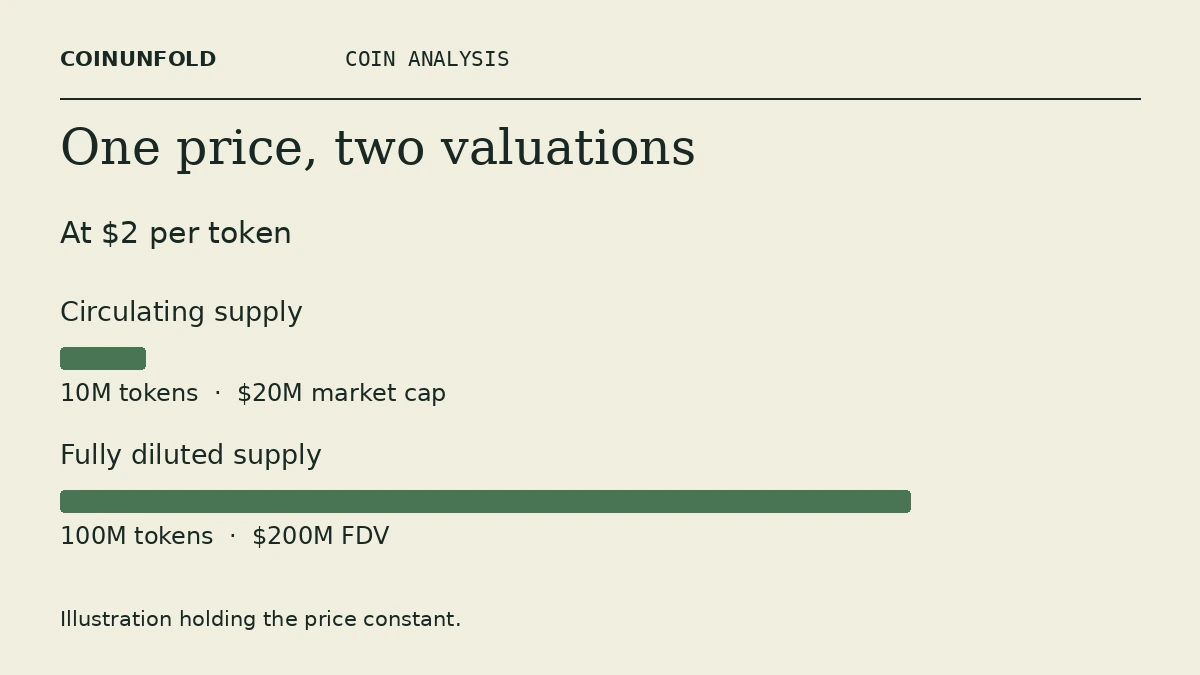
A token costs $2. There are 10 million units in circulation, and the data provider uses 100 million units for its fully diluted supply. Two different valuations can appear beside the same price. Both can be arithmetically correct.
The circulating market capitalization is $2 × 10 million, or $20 million. The fully diluted valuation (FDV) is $2 × 100 million, or $200 million. Market cap describes the value of the estimated circulating supply at the quoted price. FDV applies that price to a wider supply figure. Providers can use total or maximum supply depending on the asset and methodology, so check the denominator. CoinGecko’s methodology
What the tenfold gap tells you
In this example, the circulating supply is one tenth of the supply used for FDV. That’s a clue to investigate the remaining 90 million units. It tells you nothing on its own about their release date or whether their owners plan to sell. A five-year vesting schedule presents a different research question from a large unlock next week.
Now suppose 5 million more tokens enter circulation. At an unchanged $2 price, the circulating market cap becomes $30 million. No rule requires buyers to put $10 million of new money into the market for that number to appear. The calculation multiplied a price by a larger count. If the price instead falls to $1.50, 15 million circulating units give a $22.5 million market cap.
Why a cheap-looking coin can already be large
At $0.10 each, 1 billion circulating units imply a $100 million market cap. At $100 each, 100,000 circulating units imply a $10 million market cap. The lower-priced coin is the larger asset by this measure. Splitting an identical economic interest into smaller units can change its sticker price without changing its whole valuation.
Three checks before using FDV in a comparison
Supply date. Record the data provider and date. Check whether the supply is independently verified, self-reported or unavailable. Two providers may classify treasury or locked tokens differently. If their numbers disagree, find the definition before averaging anything.
Unlock terms. Find the issuer’s token allocation and vesting documents. Identify recipients, release dates and whether they can transfer the tokens immediately. An unlock gives someone the ability to sell. Their decision and the size of future demand are uncertain.
Market depth. A quoted trade price can come from a thin market. Trying to sell a large amount may move the price sharply. Neither the $20 million market cap nor the $200 million FDV tells you how much cash holders could collect by selling. See how trade size affects a DEX quote.
A research note can be just one sentence long if it keeps its assumptions: “At a $2 reference price, with 10 million circulating and 100 million fully diluted units, the gap is tenfold. The next fact to verify is the release schedule.” That gives you a question the project’s documents can actually answer.