
If you start with ₹10,000 in a bank and want crypto in your own wallet, a trading fee tells you only part of the story. You need an exchange that accepts your deposit, supports the asset, and will send it over the network your wallet uses. The cheapest advertised trade can lose once you price the withdrawal.
A centralized exchange (CEX) runs accounts for its customers and controls the keys for crypto held on the platform. It may offer a simple buy screen as well as an order book. Those two screens can produce different quotes at the same company.
Compare the route you’ll actually use
Start with two candidates and the same cash budget. Get as far as a preview without confirming the purchase. Write down the cash outlay, units delivered, any funding charge and the withdrawal cost on your chosen network. If one platform discloses a fee in tokens, convert it to cash using the same reference price for both comparisons. Take both quotes close together.
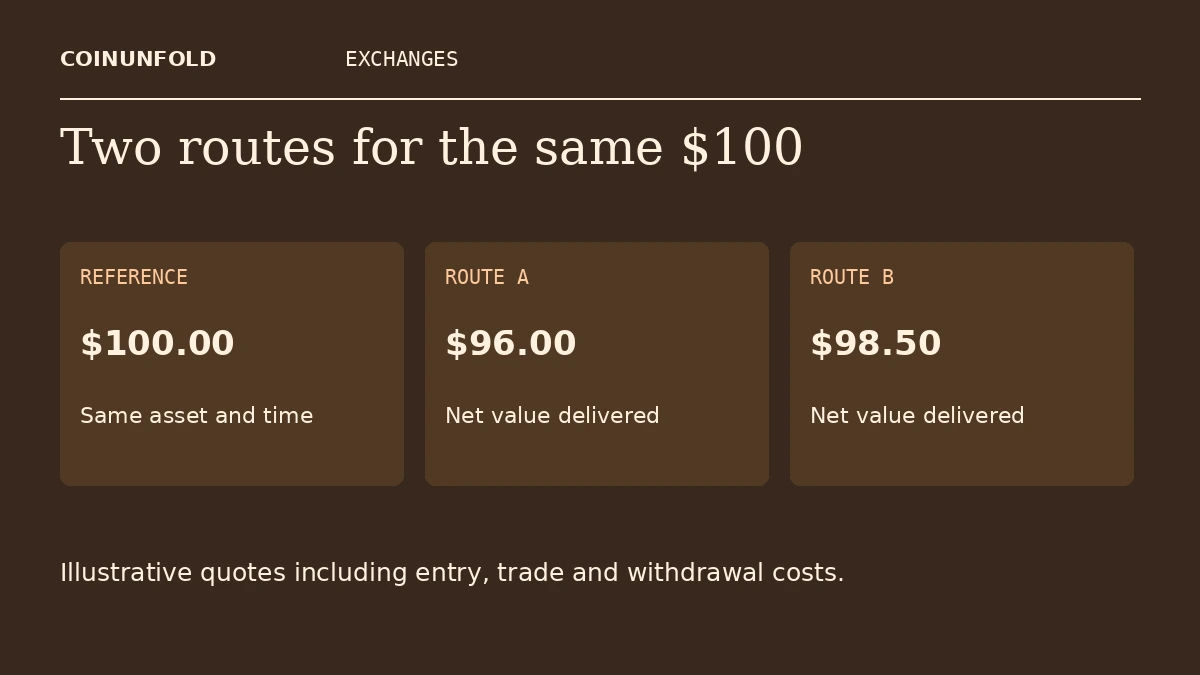
Imagine that a $100 budget would deliver $96 of an asset to your wallet on route A, after all charges. Route B delivers $98.50 at that same reference price. The difference is $2.50. It doesn’t matter which site had the smaller “trading fee” line. If you intend to leave the asset on the platform, the withdrawal is a future cost and custody becomes a more important part of the decision.
Two real fee documents worth opening
Coinbase says it includes a spread in simple buy and sell quotes. The spread is built into the price. Adding it a second time to a calculation based on actual units received would exaggerate the cost. Verify your local order preview because pricing can vary by region and payment method. Coinbase fee disclosures
Kraken’s cash deposit table breaks options down by currency, region, minimum, fee and processing time. Some methods can also trigger a withdrawal hold. That matters if your plan is to deposit today and immediately send crypto out. Read the line for the funding method your account actually offers. Kraken cash funding options
What changes between India and the US?
In India, check the legal entity behind the app and its current FIU-IND registration information where applicable. FIU registration concerns reporting obligations. It doesn’t tell you whether an INR withdrawal works today or what happens if the exchange fails. Verify the current INR deposit and withdrawal methods directly, including the account-name requirements. FIU-IND registration notices
In the US, check availability for your state and for the particular product. Access to spot purchases doesn’t establish access to derivatives, staking or every token. Check whether a bank deposit can be traded before it can be withdrawn. Readers elsewhere can use the same sequence with their local currency and jurisdiction.
Save the withdrawal terms alongside your quote. If a platform later asks for a fresh payment to an outside wallet to release your balance, stop and investigate the request. Our withdrawal-fee scam guide explains what evidence to keep.
When you compare trading costs, check how maker and taker fees work on a partially filled order.